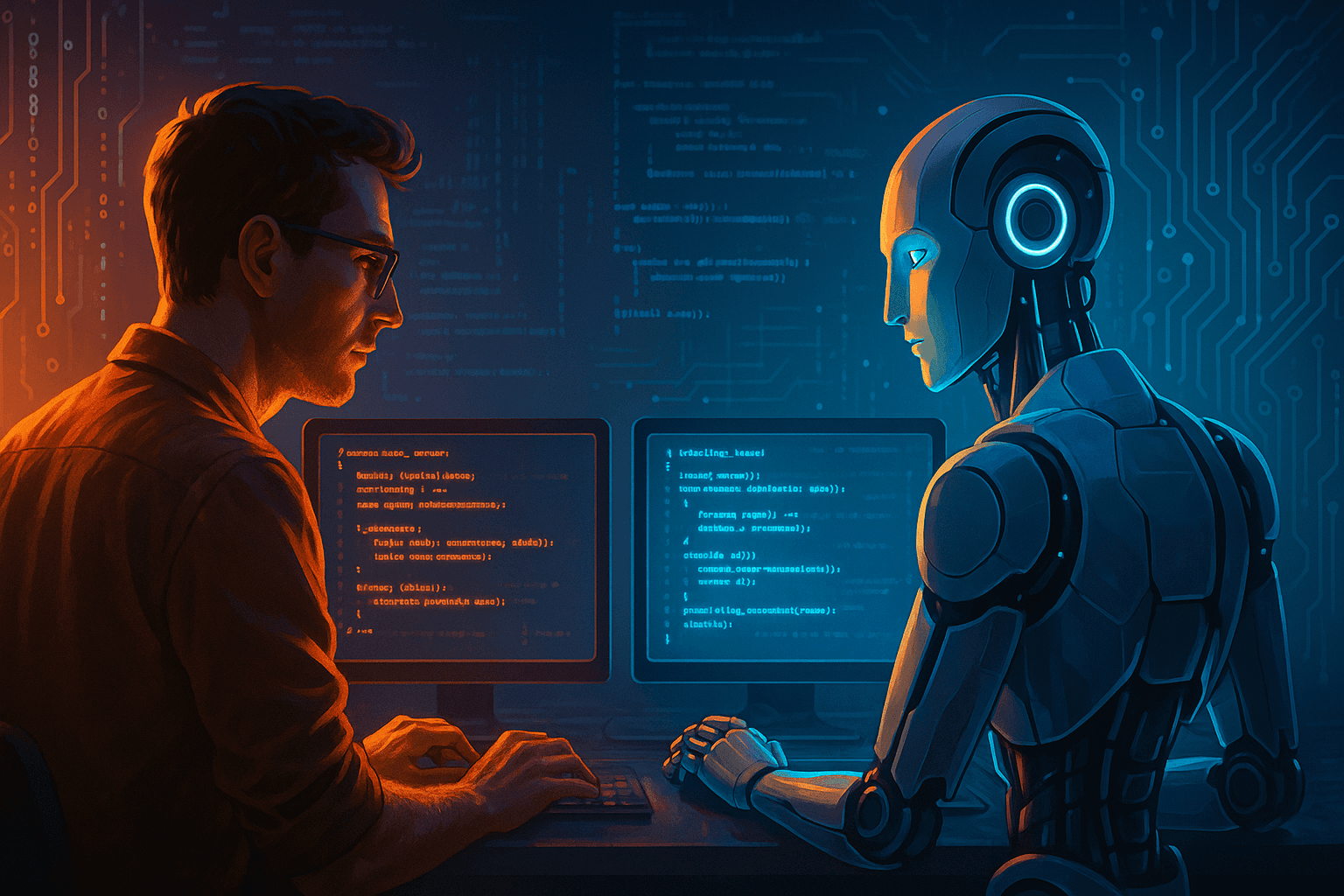
In recent years, the rise of AI-powered coding assistants like GitHub Copilot, ChatGPT, and Amazon CodeWhisperer has sparked widespread concern about the future of human programmers. Headlines proclaiming "AI will replace developers" have created anxiety across the tech industry. However, a closer examination reveals a more optimistic and realistic picture: AI isn't replacing human programmers—it's empowering them.
Key Takeaway:
AI coding tools are productivity multipliers, not replacements. They handle repetitive tasks, suggest code snippets, and catch errors—but they can't replace human creativity, problem-solving, and strategic thinking that drive innovation in software development.
The Reality: AI as Augmented Intelligence
The term "artificial intelligence" is misleading when discussing coding assistants. A more accurate description is "augmented intelligence"—technology that enhances human capabilities rather than replacing them entirely.
What AI Coding Tools Actually Do
Modern AI coding assistants excel at specific, well-defined tasks:
- Code Completion: Suggesting the next few lines of code based on context
- Bug Detection: Identifying common errors and potential issues
- Code Refactoring: Suggesting improvements to existing code
- Documentation: Generating comments and documentation
- Test Generation: Creating unit tests for functions
- Code Translation: Converting code between languages
These are all supportive tasks that enhance productivity, but they don't replace the core responsibilities of a programmer: understanding requirements, designing architectures, making strategic decisions, and solving complex problems.
Why Human Programmers Remain Irreplaceable
1. Creativity and Innovation
AI tools are excellent at pattern recognition and generating code based on existing patterns. However, they struggle with truly novel problems that require creative thinking. Human programmers bring:
- Innovative Solutions: The ability to think outside the box and create entirely new approaches
- Abstract Thinking: Understanding complex business requirements and translating them into technical solutions
- Design Intuition: Creating user experiences and interfaces that feel natural and intuitive
- Artistic Vision: Balancing functionality with aesthetics in software design
Real-World Example: When building a new mobile app, AI can help write the authentication code, but it can't conceptualize the unique user flow that makes your app stand out from competitors. That requires human creativity and understanding of user psychology.
2. Strategic Thinking and Architecture
One of the most critical aspects of software development is architectural decision-making. This requires:
| Aspect | Human Role | AI Limitation |
|---|---|---|
| System Design | Designing scalable, maintainable architectures | Can suggest patterns but can't understand long-term implications |
| Technology Selection | Choosing the right stack for specific needs | Lacks context about team expertise, budget, timeline |
| Trade-off Analysis | Balancing performance, cost, maintainability | Can't weigh business priorities and constraints |
| Future Planning | Anticipating future requirements and growth | Limited to historical patterns, can't predict trends |
3. Understanding Context and Requirements
One of the biggest challenges in software development isn't writing code—it's understanding what code to write. Human programmers excel at:
- Stakeholder Communication: Translating business needs into technical requirements
- Domain Expertise: Understanding industry-specific challenges and regulations
- User Empathy: Anticipating user needs and pain points
- Contextual Awareness: Understanding the broader business and technical environment
AI tools can generate code, but they can't sit in a meeting with stakeholders, understand the nuances of a business problem, or make judgment calls about edge cases that aren't explicitly documented.
4. Ethical Decision-Making
As AI becomes more integrated into software systems, ethical considerations become increasingly important. Human programmers are essential for:
- Bias Detection: Identifying and mitigating algorithmic biases in AI systems
- Privacy Protection: Ensuring user data is handled responsibly
- Security Considerations: Understanding the ethical implications of security measures
- Accessibility: Ensuring software is usable by people with disabilities
- Social Impact: Considering how technology affects society at large
These decisions require human judgment, empathy, and moral reasoning—qualities that AI cannot replicate.
5. Debugging Complex Issues
While AI can catch syntax errors and common bugs, complex debugging requires human intuition and systematic thinking:
- Root Cause Analysis: Tracing problems through multiple systems and layers
- Performance Optimization: Identifying bottlenecks in complex systems
- Integration Issues: Resolving conflicts between different systems and APIs
- Race Conditions: Understanding timing-dependent bugs in concurrent systems
These problems often require understanding the "why" behind the code, not just the "what"—something that requires human reasoning.
How AI is Actually Creating More Opportunities
Rather than reducing the need for programmers, AI is creating new roles and opportunities:
New Specializations Emerging
AI/ML Engineers
Specialists who build and maintain AI systems
Prompt Engineers
Experts in crafting effective prompts for AI tools
AI Ethics Specialists
Professionals ensuring AI systems are fair and ethical
AI Integration Architects
Designing systems that effectively leverage AI tools
Increased Productivity = More Projects
When developers become more productive with AI assistance, the result isn't fewer developers—it's more projects getting completed. This creates:
- More opportunities to tackle ambitious projects
- Faster iteration cycles leading to better products
- Ability to focus on high-value work instead of boilerplate
- More time for innovation and experimentation
The Future: Human-AI Collaboration
The most successful software development teams of the future will be those that effectively combine human creativity with AI efficiency. Here's what that looks like:
Optimal Workflow
- Human: Understands requirements and designs the solution architecture
- AI: Generates initial code structure and boilerplate
- Human: Reviews, refines, and adds business logic
- AI: Suggests optimizations and catches potential bugs
- Human: Tests, integrates, and ensures quality
- AI: Generates documentation and test cases
- Human: Reviews for accuracy and completeness
Skills That Will Become More Valuable
As AI handles more routine coding tasks, these human skills will become increasingly important:
| Skill | Why It Matters |
|---|---|
| Problem-Solving | Breaking down complex problems into solvable components |
| Communication | Explaining technical concepts to non-technical stakeholders |
| Critical Thinking | Evaluating AI suggestions and making informed decisions |
| System Design | Architecting scalable and maintainable systems |
| Domain Expertise | Understanding specific industries and their unique requirements |
Real-World Evidence: The Numbers Don't Lie
Despite the proliferation of AI coding tools, the demand for human programmers continues to grow:
- Job Market Growth: Software developer jobs are projected to grow 25% from 2022 to 2032 (much faster than average)
- Salary Trends: Developer salaries continue to rise, indicating strong demand
- Industry Adoption: Companies using AI tools report increased productivity, not reduced headcount
- New Roles: Entirely new job categories are emerging around AI integration
Industry Insight: Companies like GitHub report that developers using Copilot feel more productive and satisfied with their work, not threatened. The tool helps them focus on interesting problems rather than repetitive tasks.
How to Thrive in the AI Era
For programmers concerned about AI, here's how to position yourself for success:
1. Embrace AI Tools
Learn to use AI coding assistants effectively. They're tools that make you more productive, not threats to your job.
2. Focus on High-Value Skills
Develop skills that complement AI rather than compete with it: architecture, problem-solving, communication, and domain expertise.
3. Understand AI Limitations
Learn what AI can and can't do. This knowledge helps you use it effectively and identify when human judgment is needed.
4. Stay Curious and Adaptable
The tech industry evolves rapidly. Continuous learning and adaptability are your greatest assets.
Conclusion: A Partnership, Not a Replacement
The narrative that AI will replace human programmers is not only incorrect but also counterproductive. The reality is far more exciting: AI and human programmers are forming a powerful partnership that's transforming software development for the better.
AI handles the repetitive, pattern-based tasks that can be automated. Humans focus on the creative, strategic, and complex problem-solving that drives innovation. Together, they create software that's more robust, innovative, and impactful than either could achieve alone.
The Bottom Line
AI isn't replacing human programmers—it's making them more powerful. The developers who embrace AI tools and focus on developing uniquely human skills will be the ones who thrive in this new era of software development. The future belongs to those who can effectively collaborate with AI, not those who fear it.
So, if you're a programmer worried about AI, take heart: your job isn't going away. It's evolving, and that evolution is creating more opportunities, not fewer. The key is to adapt, learn, and leverage AI as the powerful tool it is—a tool that amplifies human capability rather than replacing it.